

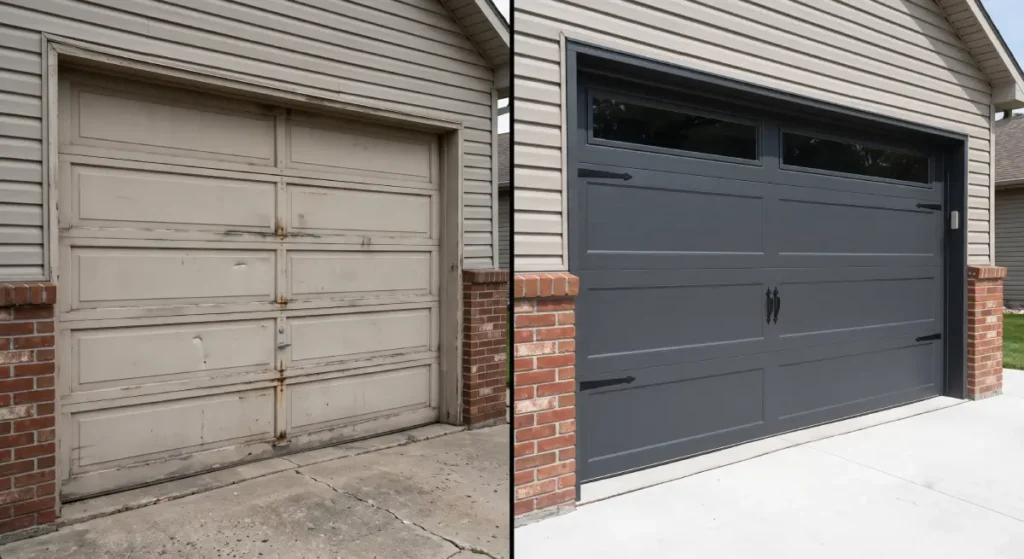
A new garage door returned 268 percent of its cost at resale in 2025. A $164,000 upscale kitchen remodel returned 36 percent. Both count as “renovating before selling,” and that gap is the entire answer to this question.
Sellers face this decision under pressure: list now and accept lowball offers, or spend months and tens of thousands chasing a higher price. Zillow found 65 percent of recent sellers took on at least two improvement projects before listing, yet more than a quarter of first-time sellers still believe they under-invested.
Get the scope wrong in either direction and you lose real money. Under-prepare and buyers discount the home hard. Over-improve and you donate your renovation budget to the next owner.
This article gives you the data, the decision rule, and the specific projects that pay back, so you can answer the question for your house, not the average one.
The Short Answer
It depends on what “renovate” means. Repairs that fix visible defects almost always pay. Cosmetic refreshes like paint, hardware, and landscaping usually pay. Full remodels of kitchens, baths, or additions almost never pay when done purely to sell.
The pattern in the data is consistent: the smaller and cheaper the project, the higher the return. The rest of this article shows why, and where your specific situation might break the rule.
What 2025 Resale Data Actually Shows
Zonda’s 2025 Cost vs. Value Report, the industry’s standard ROI benchmark, found that eight of the ten highest-returning projects were exterior replacements. Curb appeal work costs little, requires no design decisions, and shapes a buyer’s opinion before they reach the front door.
| Project | Approx. Cost | Cost Recouped at Resale |
| Garage door replacement | Under $5,000 | 268% |
| Steel entry door replacement | ~$2,500 | ~180% |
| Manufactured stone veneer | ~$11,000 | ~150% |
| Minor kitchen remodel (midrange) | ~$28,500 | 113% |
| Bath remodel (midrange) | ~$28,000 | 80% |
| Basement remodel | ~$60,000 | 71% |
| Major kitchen remodel (upscale) | ~$164,000 | 36% |
| Primary suite addition (midrange) | ~$164,000+ | 32% |
Source: Zonda / Remodeling Magazine 2025 Cost vs. Value Report, national averages. Regional numbers vary widely; the South Atlantic garage door figure, for example, was 228 percent, not 268 percent.
Read the table bottom-up and the lesson is blunt. Every project over roughly $50,000 loses money at resale. The only interior project in the top five was the minor kitchen remodel: new cabinet fronts, hardware, countertops, and appliances in the existing footprint.
The Move-In-Ready Premium
Buyers now punish homes that need work harder than at any point since Zillow began tracking listing keywords. In its analysis of two million 2024 listings, homes described as “remodeled” sold for nearly 4 percent above expectations, about $13,200 on a typical U.S. home. That was the largest premium of all 359 keywords studied.
The penalty runs the other direction too. Zillow’s 2026 research put the turnkey premium at roughly 2.9 percent, while homes marketed as fixer-uppers sold for around 14 percent less than comparable properties.
Before the pandemic, “needs TLC” listings could still attract bargain hunters. Post-2024, remodeled listings get 26 percent more daily saves on Zillow and get shared with a co-shopper 30 percent more often. Buyers stretched thin by mortgage rates have no budget left for contractors.

The Paradox: Buyers Pay More, Sellers Still Lose Money
Here is where most advice contradicts itself. Zillow says buyers pay a premium for remodeled homes. Zonda says most remodels recoup a fraction of their cost. Both are true, and the gap between them decides your strategy.
The remodeled-home premium mostly rewards owners who renovated years ago for their own use and are now selling. They absorbed the cost over years of enjoying the kitchen. A seller who remodels in March to list in June pays 100 percent of the cost to capture a 3 to 4 percent price bump.
Run that math on a $400,000 home. The turnkey premium is worth roughly $12,000 to $16,000. A minor kitchen refresh at $28,500 that recoups 113 percent captures most of that premium and turns a small profit. A $164,000 remodel chasing the same premium loses six figures.
This is why Zillow’s own seller guidance warns against last-minute renovations. The premium is real. Buying it at retail price weeks before listing is what fails.
When Renovating Before Selling Pays
Renovation-scale work makes sense in a narrow set of cases.
A defect is blocking financing
A failing roof, dead HVAC, or active leak can make the home ineligible for FHA and VA loans, cutting your buyer pool to cash and conventional-only. HUD’s Title 1 and 203(k) home improvement loan programs exist for exactly this situation, but as a seller, fixing it before listing isn’t about ROI. It’s about being sellable at all.
One room is far below the home’s tier
If every comparable sale in your neighborhood has an updated kitchen and yours has 1987 oak and laminate, buyers will mentally deduct a full remodel’s cost, usually more than the work would cost you. A minor kitchen remodel closes that gap at 113 percent ROI.
Your market rewards turnkey and inventory is tight
In competitive metros, move-in-ready homes trigger multiple offers while dated ones sit. Your agent’s data on days-on-market for updated versus dated comps settles this.
The fix is cheap and visible
Paint, garage door, entry door, landscaping, lighting, and hardware. Zillow found interior painting was the single most common pre-sale project, chosen by 46 percent of sellers, for a reason: low cost, photographs well, no permit, one week.
Many agents now bring in a Creative Property Stylist before photos are taken rather than after a renovation is done. A stylist can reposition existing furniture, swap hardware, and adjust lighting to make a dated room photograph like a refreshed one, often closing part of the gap a full remodel would have covered, at a fraction of the cost.
When Selling As-Is Wins
Skip the renovation entirely in four situations.
The home needs everything
If the kitchen, baths, roof, and systems are all dated, partial updates read as lipstick and full updates cost more than you’ll recover. Price for investors and renovator-buyers instead, and keep the months of carrying costs.
You’re already at the neighborhood ceiling
Appraisers cap value against local comps. If nearby homes top out at $350,000, a $60,000 renovation on your $330,000 house cannot appraise its way to $410,000. The buyer’s lender won’t allow it.
You need to sell fast
A remodel adds two to five months of mortgage, taxes, insurance, and utilities before you even list. If the market is softening, that delay can erase the price gain by itself.
The buyer will gut it anyway
Teardown-adjacent lots, estate sales in hot land markets, and homes priced on location sell on dirt value. Renovation money is a pure waste here.
The Repair, Refresh, Remodel Rule
Sort every candidate project into three buckets.
Repair: do it
Anything broken, leaking, or flagged in a pre-inspection. Buyers assume one visible defect hides five invisible ones and discount accordingly. Repairing before listing usually costs less than the closing credit a buyer would demand for the same issue.
Refresh: usually do it
Paint, landscaping, garage and entry doors, fixtures, deep cleaning, decluttering, and a minor kitchen or bath refresh if those rooms lag the neighborhood. These are the 80 to 268 percent ROI projects.
Remodel: almost never do it
Additions, layout changes, upscale kitchens and baths, primary suites. These return 32 to 36 percent of cost. Do them for yourself, years before selling, or not at all.
For owners who decide the work is worth doing for their own use rather than for resale, the sequence of budgeting, contractor selection, and permits determines whether the project stays on schedule.
The Costs Sellers Forget to Count
ROI tables understate the true cost of pre-sale renovation because they omit three items.
Carrying costs
A three-month remodel on a home with a $2,400 monthly mortgage plus taxes and utilities adds roughly $8,000 to $10,000 before a single buyer walks through. Subtract that from any projected gain.
Contractor risk under deadline
Rushed projects run over budget and past schedule, and you have no leverage to wait for the good contractor when the spring listing window is closing. Zillow’s data shows the typical U.S. home listed in the prime late-spring window sold for about $5,600 more. Miss it and the remodel cost you twice.
The over-improvement trap
Every dollar spent above your neighborhood’s price ceiling returns zero. Pull three recent comps before approving any budget, and cap total spend so the after-renovation price stays inside the comp range.
How to Decide in One Afternoon
- Get a pre-listing inspection. For $300 to $500, it surfaces the repair bucket and prevents buyers from weaponizing surprises during negotiation.
- Ask two or three agents for a dual CMA. Request the estimated sale price as-is versus after specific improvements. Agents do this free, and the spread is your real budget ceiling.
- Fund projects in ROI order. Repairs first, then paint and curb appeal, then a minor kitchen or bath refresh only if the CMA spread justifies it.
- Stop when the next project’s cost exceeds two-thirds of its projected price gain. That margin covers carrying costs and contractor overruns.

Conclusion
So, is it better to renovate before selling? It depends on scope, and the honest answer has three parts. Repairs: yes, nearly always. Cosmetic refreshes: usually, because paint, curb appeal, and minor kitchen work returned 80 to 268 percent of cost in 2025. Full remodels: almost never, because upscale projects returned 32 to 36 percent and the move-in-ready premium tops out around 3 to 4 percent of sale price.
Buyers genuinely pay more for turnkey homes, but that premium is too small to fund a last-minute remodel. Capture it with the cheapest projects that make the home photograph and inspect well, verify the math against your neighborhood’s comps, and let the next owner pay for the dream kitchen.







Leave a Comment